Key Takeaways
- Pinhole glasses work by blocking unfocused light rays which creates a sharper image while you are wearing them but does nothing permanent for your vision.
- They are primarily a diagnostic tool used by eye doctors rather than a practical solution for everyday vision problems.
- Taking off pinhole glasses brings your vision straight back to exactly where it was before which tells you everything you need to know about their long term value.
- Wearing pinhole glasses while using screens can actually make eye strain worse rather than better so they are not the digital eye solution some people claim.
- For genuine vision correction a proper prescription from an eye professional and quality lenses will always be the more reliable and honest choice.
What are pinhole glasses and why are they used? Do pinhole glasses improve eyesight? There is a lot more you wanted to know about the glasses, that looks way different from the regular clear glasses.
Here let’s delve deeper into the topic and understand the magic of these dark dotted glasses and how they help in vision improvement.
What exactly are pinhole glasses?
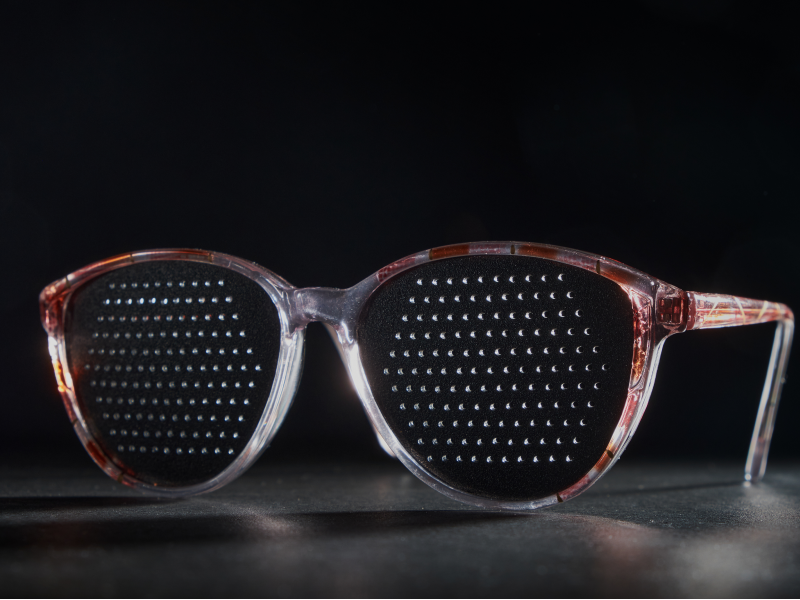
Pinhole glasses are also known as “stenopeic glasses” are essentially made of plastic with a grid of tiny holes in the place of lenses. With the primary purpose of removing the indirect rays of light distorting your vision. Pinhole glasses help in many refractive errors and focus clearly.
How do pinhole glasses work?
Before understanding the working of pinhole glasses to help your vision, let’s talk about how glasses or contact lenses work. If someone is suffering from a refractive error, prescription glasses refract the light passing through them to converge on the retina, to enable them to see clearly.
Instead, Pinhole glasses work very differently by limiting the light incident on them, thus eliminating the unfocused rays that cause blur circles in front of the retina and allowing only focused rays to form sharp images.
So, pinhole glasses work the same as the effect created while you squint to adjust the light reaching the eye.
Who might benefit from pinhole glasses?
Pinhole glasses have several uses. Some people with a refractive error often use these glasses to treat nearsightedness or astigmatism. They are popularly used by eye doctors, optometrists or ophthalmologists to better determine any vision impairment.
Doctors use them as a diagnostic tool for checking the prescription of one eye while covering the other eye completely with an occluder.
Here the pinhole glasses help you improve your visual acuity when reduced vision is due to some refractive error. But, if the pinhole doesn’t help, it might be an indication of another eye problem.
Moreover, they are also used to effectively determine if a person is suffering from corneal distortion or cataracts.
The process of detecting the vision impairment involves focusing light on the eye to determine whether the vision capability of eye lenses behind the cataract is worth undergoing surgery or not.
Do pinhole glasses work to improve vision?
In general, pinhole glasses are only used as a diagnostic tool by doctors to determine eye alignment. Meanwhile, they are not an ideal choice for everyday use. However, some people claim using pinhole glasses to treat myopia, hyperopia, and glasses for astigmatism, with no conclusive evidence or a trial to prove their effectiveness.
Pinhole glasses for myopia:
For a person suffering from myopic or nearsightedness, pinhole glasses may help you see clearly.
Even though we can’t doubt their effectiveness in making an object look more clearer while blocking light rays out from the focus. They may affect image quality and form a dimmer image instead of usual.
Furthermore, The pinhole glasses only allow optimally direct light to pass through them while blocking the part of non-optimal direct and peripheral vision. Thus, again making them aren’t functional for everyday use and activities like driving or operating machinery.
Pinhole glasses for astigmatism:
Same as the case with people with astigmatism. Pinhole glasses simply block the light rays that aren’t aimed to converge on the right spot of the retina and only allow focused light to pass.
Admittedly, they don’t treat your eye alignment permanently and you will get back to your usual vision as soon as you take them off.
Pinhole together with eye exercise:
Some people also support pinhole glasses suggesting using them together with eye exercising can improve your vision permanently. Though it may seem true for one or two fortunate cases when people saw a vision improvement through eye exercising, there is no evidence to support the concept when pinhole cure or permanently address refractive error.
Essentially when you wear pinhole glasses, they give you extra clarity but it is only for a period you wear them.
Don’t reduce eye strain:
Another myth that surrounds pinholes is that they help reduce eye strain caused by pseudomyopia, a spasm in focusing muscle. But it is not true, pinhole doesn’t address the cause of digital eye strain. Moreover, wearing them while bling watching or for screen usage, can only make the symptoms worse with headache and tired eyes.
Your best bet here is to use blue light glasses to eliminate glare from digital devices hitting your eye and wear contact or prescription glasses for vision improvement.
How to make pinhole glasses at home:
Looking to make pinhole glasses for yourself to understand what wearing them looks like? Here are the simple steps you can try at home to make one.
- Take an old pair of glass frames you no longer use.
- Next, wrap a piece of aluminium foil over it.
- Take a sewing needle or a pin.
- Poke holes on the aluminium foil with the needle.
With the pair in hand, you are good to enjoy clearer vision with a pinhole glass pair made by you.
Wrapping up:
Today many companies, including those advertising on the internet, are also claiming pinhole glasses as a treatment of myopia, reducing myopia and digital eye strain, improvement in vision, or other exaggerated benefits.
Hopefully, the article helps you understand the truth behind all those claims. Now instead of falling for the temptation of the magic with pinhole glasses, invest in a high-quality pair of contact lenses or eyeglasses.
FAQs
Q1. What exactly are pinhole glasses and how are they different from regular glasses?
Instead of clear lenses they have a solid opaque surface with a grid of tiny holes punched through it. Those holes limit the light entering your eye to only the most focused rays which reduces blur and creates a sharper image. They look unusual and work very differently from prescription lenses but the underlying idea is actually quite simple.
Q2. Do pinhole glasses actually improve your eyesight?
While you are wearing them they can make things look clearer yes. But the moment you take them off your vision goes straight back to what it was before. There is no evidence that wearing them regularly leads to any permanent improvement in vision despite what some companies will try to tell you.
Q3. So who actually uses pinhole glasses anyway?
Mostly just eye doctors and optometrists use them as a tool to help test stuff and check if your prescription is right. They kinda help figure out if your blurry vision is just a normal eye issue or something else like cataracts maybe. Honestly though, outside the office they aren’t very useful.
Q4. Can pinhole glasses help with myopia or astigmatism?
They can make vision temporarily clearer for people with these conditions by filtering out unfocused light. But they do not treat or correct either condition in any lasting way. Think of them as a temporary workaround rather than a solution and you will have the right expectations going in.
Q5. Is it true that combining pinhole glasses with eye exercises can fix your vision?
This gets talked about online quite a bit but there is no solid clinical evidence to back it up. A small number of people report improvement but there is nothing to suggest that pinhole glasses combined with exercises reliably addresses refractive errors in any meaningful or permanent way.
Q6. Can I wear pinhole glasses to reduce digital eye strain?
This is actually one of the more persistent myths around pinhole glasses and it is worth clearing up. They do not address the cause of digital eye strain and wearing them in front of a screen can actually make symptoms worse including headaches and tired eyes. Blue light glasses are a much better option for screen use.
Q7. Are pinhole glasses safe to wear while driving or doing daily activities?
No and this is a serious one. Pinhole glasses restrict peripheral vision significantly which makes them genuinely unsafe for driving, operating machinery, or any activity where full visual awareness is important. They are really only appropriate for short diagnostic use in a controlled setting.
Q8. Can I make pinhole glasses at home?
You can actually and it is surprisingly straightforward. Take an old frame, wrap aluminium foil over the lens area, and use a pin or sewing needle to poke a grid of small holes through it. It will not replace proper eyewear but it gives you a good sense of how pinhole glasses work and what wearing them actually feels like.