Key Takeaways
- If you wear prescription glasses and spend any real time outdoors, clip-on sunglasses solve a genuinely annoying daily problem without breaking the bank.
- Getting the right size and shape is everything with clip-ons because a poor fit means poor coverage and that defeats the entire purpose.
- Magnetic clip-ons are the most convenient option right now but they do carry a real risk of scratching your prescription lenses over time with repeated use.
- Always check for 100 percent UV400 protection when buying clip-ons because not all of them offer the same level of coverage despite looking similar.
- Clip-ons are not perfect but for frequent travellers and people who hate carrying two pairs of glasses everywhere they are a genuinely practical solution.
At the onset of summer or the call for outdoor fun, you can’t forget the harmful effect of UV rays hitting your skin as well as your eyes. Though sunglasses can help you shield your eyes while looking fashionable. Striking the right balance between functionality and fashion by Wearing glasses isn’t easy for everyone.
If you are an eyeglasses wearer who travels frequently, you might be familiar with the tiresome experiences of switching between prescription glasses and sunglasses. That being said, clip-on sunglasses come in as an alternative to alleviate the pain of wearing one and carrying the other gear along wherever you go.
What are clip-on sunglasses?
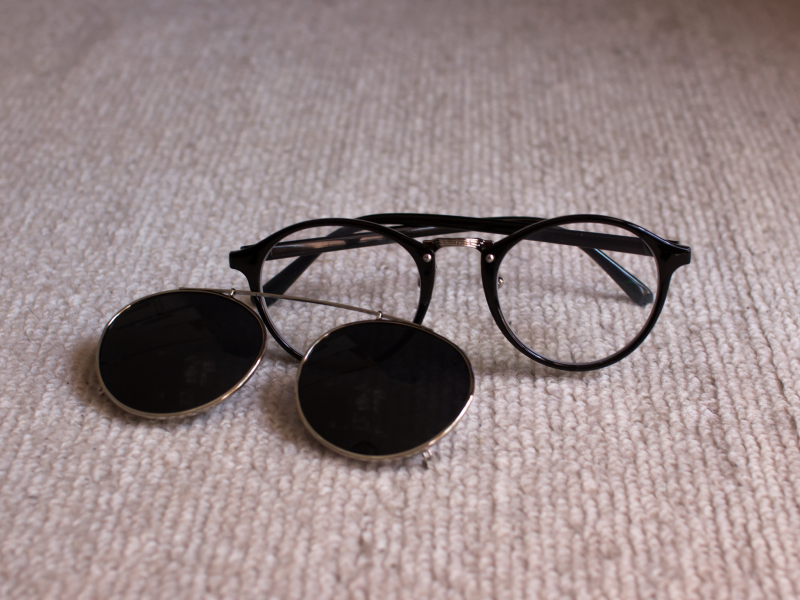
A style quotient and a practical accessory, clip up sunglasses fit in your existing optical frame and protect the eye against UV rays.
They are designed in a variety of tint, styles, shapes, sizes, and UV protection layers to match up with the optical lenses and work as sunglasses.
But unlike the regular frames, they don’t have arms. They are uniquely crafted with a set of two darken lenses linked together and a clip or magnet attached to the bridges to fix them on your regular prescription glass frame.
Clip-on sunglasses – Do they work:
Advertised as a gear to make switching between prescription and sunglasses at ease, clip-on sunglasses work well to shield your eye against annoying glare and harmful sun rays until they are fitted properly and go well with your existing glasses. The only real consideration you need to make is to choose the right size and shape of the clip-on sunglasses to fit in the current frame.
How are clips on glasses measured?
The size of clip-on glasses is determined by keeping sunglasses in mind. Determine the size or the special design of your frames. Whether you have a round or cat-eye or a rectangular frame shape. Meanwhile, the length and height of frames, bridge type, and other features are also important considerations, when you want to shop for a clip-on that perfectly fits your regular eyeglasses.
Not good at measuring the frames? Look for the number printed on the side of your glasses for quick estimating the bridge and frame size.
Shopping for clip-on sunglasses in NZ? Things to keep in mind:
Types of clip-on sunglasses:
There are three types of clip-on sunglasses known as standard clip-on, flip clip-on, and magnetic clip-on.
Standard clip-on:
With an extended clip at the centre of the bridge on the nose, the standard form clip-on sunglasses hook onto the regular glasses. Here it is noted that they are detachable – you can easily put them on when UV protection is needed and take them off when visual clarity is needed.
Flip-up clip-on:
Also known as magnetic flip-up sunglasses, the typical sunnies are different from the standard ones. Though not completely replaced or reinserted, you can flip them up whenever needed to enjoy the unobstructed clear and corrected vision of prescription glasses or clip them on to safely stay under the sun.
Magnetic clip-on:
Last but not least, the magnetic type clip-on sunglasses have an invisible magnet attached to them that easily sticks the clip-on pair to your frames.
Featuring magnetic sides all along with the frames, they are popular in the market today and pair well with titanium frames.
Adequate amount of UV protection:
Same as conventional sunglasses, a clip-on comes in a variety of sizes, shapes and coatings. Thus while looking to buy a clip-on, it is important to consider the pair that offers complete protection against UV rays. Make sure to buy a pair with 100% protection against UV400.
Find a clip-on with the same size and shape:
Make sure your clip-on should completely cover the prescription lenses. The thumb rule is to always measure the perfect shape and size of existing prescription lenses and order the right fit. You can easily determine the lens sizes, reading the number printed on the inside of the frame.
Pros of clip-on sunglasses:
Save money:
Clip-on sunglasses are inexpensive than buying a whole pair of shades.
Convenience:
Saving you from the hassle of carrying both prescription and shades all along, they can be tossed easily in a pocket or carry-ons.
Style:
Not just functional to save your eye, with many cool colours and shades to experiment with clip-on sunglasses can help you make a great fashion statement.
Flexibility:
They come in a variety of shapes and sizes to match with existing pairs. Furthermore, it offers several coatings, says anti-glare, polarized etc. to protect your eye.
Cons of clip-on sunglasses:
Low coverage:
When prescription lenses have a smaller frame size, clip-on tend to offer less coverage. Thus, your eyes are exposed to light glare coming from top, bottom and sides.
Fragile:
Though inexpensive, clip-on glasses made up of cheaper and flimsy material breaks quite easily. As a result, they may not be a reliable option and need steady handling.
May scratch eyeglasses:
With magnetic clip-on, another significant disadvantage is they are not good for your prescription lenses. Constantly putting on and off clip-on may scratch or wear off these lenses.
Haven’t made up your mind yet?
Clip-on or convention tinted glasses? When you are a frequent traveller- looking for a hassle-free option of switching glasses between outdoor or indoor use, clip-on sunglasses are a clear winner.
To offer better protection, clip-on glasses can have mirrored, polarized and coloured tinted lens coating.
So whether or not to choose them is just a matter of personal preference and taste.
FAQs
Q1. Do clip-on sunglasses actually work or are they just a compromise?
They work genuinely well when the fit is right and that is really where the whole conversation starts and ends. Get the size wrong and you get gaps, poor coverage, and a clip that wobbles every time you move your head. Get it right and honestly most people forget they are even wearing them after the first hour.
Q2. What types of clip-on sunglasses are out there?
Three main ones. Standard clip-ons hook onto the bridge and come off completely when you step inside. Flip-ups stay attached but fold out of the way which a lot of people find less fiddly throughout the day. Magnetic ones snap on and off with almost no effort and are probably what most people reach for these days when they want something quick and convenient.
Q3. How do I find the right size without getting it wrong?
Look on the inside of your current frames. There will be a series of numbers printed there that tell you the lens width, bridge size, and arm length. Use those when you shop rather than eyeballing it because a clip-on that almost fits is basically one that does not fit at all. Full coverage over your prescription lenses is what you are aiming for.
Q4. Will magnetic clip-ons scratch my prescription lenses over time?
There is a real risk there if you are snapping them on and off multiple times a day over months. It is not something that happens overnight but it does happen and it is worth thinking about before you commit to the magnetic style. If your prescription lenses have a special coating this becomes even more of a concern. Flip-up styles sidestep this problem entirely since they never fully detach.
Q5. What UV protection level should I actually be looking for?
100 percent UV400 and nothing below that. Some clip-ons look perfectly fine and are priced reasonably but offer very little real protection against harmful rays. The tint might make things look darker but darkness is not the same as protection. Check the UV rating before you buy and do not just assume it is covered.
Q6. What are the real downsides nobody talks about upfront?
Smaller frames mean less coverage full stop. Light still creeps in from the sides, top, and bottom in a way that a proper wraparound sunglass would block entirely. Cheaper clip-ons also tend to feel flimsy and need careful handling which gets old quickly. And if you are rough with magnetic ones your prescription lenses will eventually show the signs of it.
Q7. Are they actually worth it for someone who travels constantly?
For frequent travellers they make a lot of sense honestly. Managing two separate pairs of glasses through airports, different climates, and constantly changing light conditions is more of a headache than it sounds. Clip-ons are light, compact, and easy to slip into a carry on bag which takes one small but genuinely annoying problem completely off the table.
Q8. Can I get clip-ons with polarised lenses or is it just basic tinting?
Polarised clip-ons absolutely exist and if you drive regularly, spend time near water, or find yourself squinting a lot in bright conditions they are worth the slight extra cost. There are also mirrored and coloured tint options available so it is not just a choice between dark and less dark. A bit of research before buying means you can actually match the lens type to how and where you spend most of your time outdoors.